
For Immediate Release: April 21, 2026
Billionaire Wealth Grew 24% Since 2024 Election While Health Care Costs Soar, Health Access Declines and Millions Lose Coverage
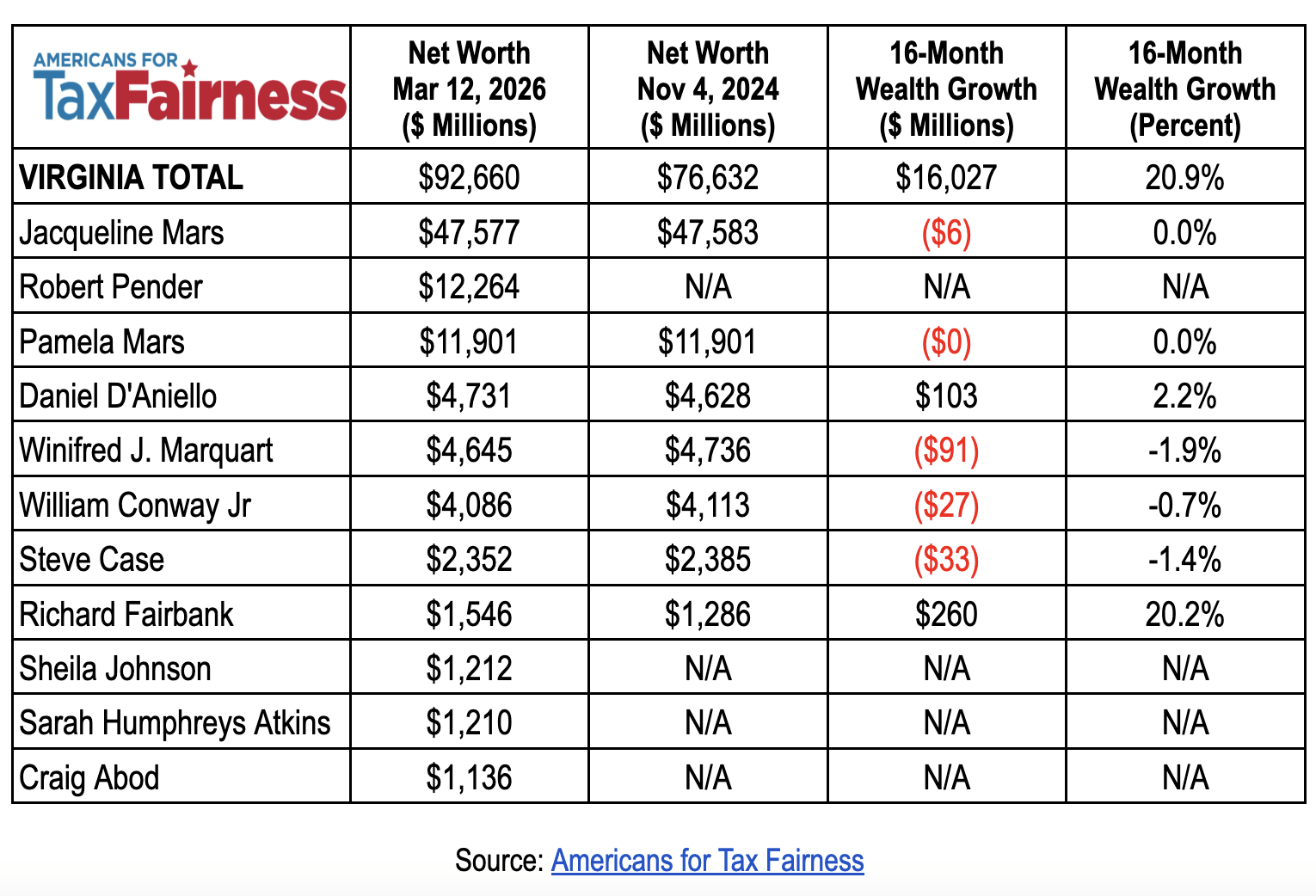
Charlottesville, VA – This Tax Day 2026, after a year of fiscal policies enacted by the current administration and Congress that reward the wealthy, Virginia billionaires are flying high while the state’s workers and families struggle to afford basic health care. In just the 16 months since the 2024 election, the collective fortune of Virginia’s 11 billionaires has grown by $16 billion, or 21%, according to a new report released today by Virginia Organizing and Americans for Tax Fairness (ATF).
“The return of Donald Trump has been a boom for billionaires but a bust for average workers and families,” said David Kass, ATF’s executive director. “Republican policies, like the One Big Beautiful Bill Act (OBBBA), keep giving more to those who already have a lot while taking from those with too little to spare. America will continue to struggle with an affordability crisis until we finally pull the plug on GOP trickle-down economics and start demanding the rich and corporations pay their fair share of taxes. That’s the only way we can build an economy that helps workers and families deal with the affordability crisis.”
“Our billionaires do not carry the burden of choosing groceries over prescription drugs or doctor visits over childcare services, because there’s not enough funds to go around. Virginians need lower prescription drug costs, affordable childcare and healthcare, and, especially, access to nutritious foods. Yet 300,000 Virginians will soon face these challenges, and this impact will increase as a result of the cuts to Medicaid in the OBBBA and the changes to the Affordable Care Act. As the rich grow richer through tax cuts, the average working people are forced to remain in the struggle,” said Virginia Organizing Chairperson Patrice Smallwood.
Those tax cuts were partially paid for through cuts to basic services, including Medicaid which the GOP cut by nearly $1 trillion dollars. Millions of people of all ages depend on Medicaid, including low wage and gig workers who don’t have access to employer sponsored coverage, children, people with disabilities, seniors and pregnant or post-partum women. In Virginia, Medicaid covered 1,520,000 children and adults last year or as much as 28% of the population in some Congressional districts.
Because of the cuts to Medicaid as well as Congress’s refusal to extend enhanced premium tax credits to make ACA coverage more affordable, 15 million people will likely lose healthcare over the next eight years including 300,000 in Virginia. Millions who retain coverage will be forced to pay much more for their insurance on ACA marketplaces with some enrollees paying double or even triple for equivalent or inferior coverage compared to what they purchased with the enhanced premium tax credits last year.
Even people who don’t depend on ACA or Medicaid for their coverage will be impacted by health policy changes under the One Big Beautiful Bill Act. Medicaid is the lead funder of rural hospitals, drug treatment centers, nursing homes and long-term care facilities. Because of the funding cuts, 600 hospitals, clinics and nursing homes are at risk of closure, particularly facilities in rural and underserved areas where health care is already hard to access. More people will have to travel a greater distance, at greater expense, to access health care even if they have coverage to pay for it.
Moreover, the new law also jeopardizes health by taking nutrition assistance away from four million people and reducing food stamp amounts for others even though the price of many food products continues to increase. Adequate nutrition is essential for good health and improving health outcomes.
In addition, the federal administration has unilaterally imposed a dizzying array of tariffs on imports from around the world which are also creating cost burdens for families. Carefully crafted tariffs can be one tool for protecting domestic industries and jobs. But this scattershot approach, targeting both friendly and unfriendly trading partners, has the main impact of raising costs for American families. (Even after the Supreme Court found the basis of many of the original tariffs unconstitutional, many of the tariffs were reinstated under a different authority.)
The combination of tax and service cuts plus the tariffs will saddle the lowest-income 80% of Virginia residents–four out of five people–with an average of $844 in higher costs this year, according to an ATF analysis of data from the Institute on Taxation and Economic Policy (ITEP). The same analysis shows the highest-income 1% will each enjoy on average a cumulative savings of $10,270.
FEDERAL FISCAL POLICIES: Those Helped and Those Harmed
This Tax Day, as Americans settle up with the IRS, there’s another calculation to be made, one that identifies the winners and losers from federal fiscal policies. Congressional choices on taxes, spending and tariffs over the past year have benefited rich households and big corporations while making life less affordable for everyone else. Only bold, comprehensive tax reform can reverse this outcome by ensuring the rich and corporations contribute a fairer share to our national prosperity, while at the same time restoring affordable access to health care that everyone needs to take care of themselves and their families.
HELPED: Rich Members of Congress
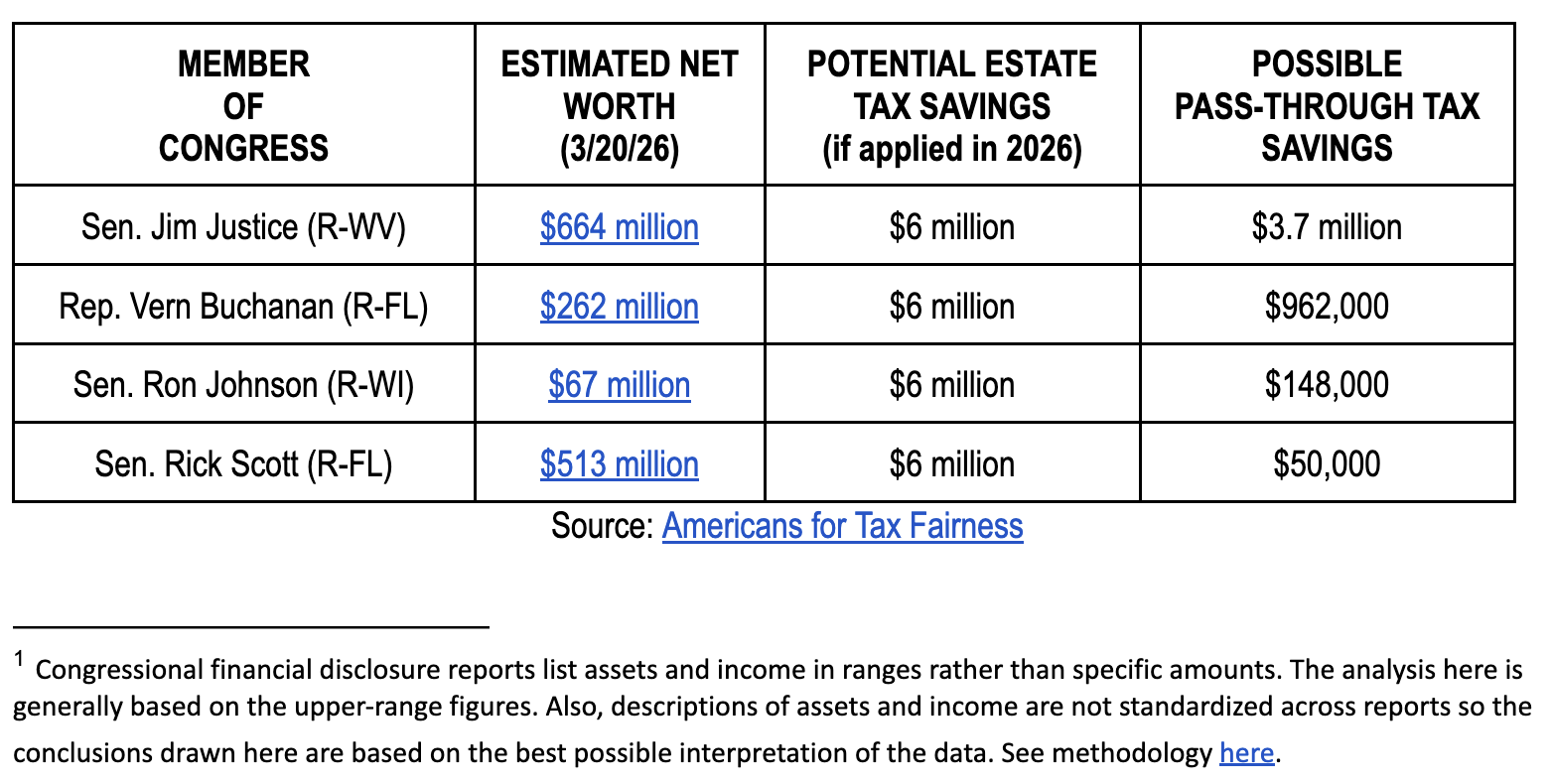
Members of Congress are among the few Americans who can help set their own tax rules. Through their votes, senators and representatives can help lower or raise rates, open or close loopholes, initiate or end special breaks. The wealthier a member of Congress is and the more income he has the greater his personal interest in crafting the tax code.
Rich members of Congress who may have benefited from the law they voted for include:
HELPED: Big Corporations
Even though the main focus of the 2025 OBBBA was the permanent extension of individual tax cuts that were scheduled to expire–cuts that heavily favored the wealthy–big corporations also received costly tax handouts.
Bonus Depreciation
According to standard accounting rules, the cost of long-lasting equipment such as machinery and vehicles purchased by a business is supposed to be deducted in equal pieces over time to reflect the slow loss of value. But the new law instead lets firms deduct the full cost of big-ticket purchases in the year acquired. This huge break for business will cost $363 billion in lost revenue over the next decade. The revenue loss from this one tax break is almost double the amount cut from food assistance in the law, a cut that imperils the nutritional health of some four million people.
Huge corporations are among the biggest beneficiaries of this tax loophole. Amazon cut its tax bill by $6.5 billion last year alone thanks to bonus depreciation, Meta (Facebook) by $4.9 billion, and Alphabet (Google) by $3.3 billion.
Research and Experimentation Expensing
For the last several years, companies have been required to deduct over time (amortize) the cost of research and experimentation. This reflects the long-term benefits of much research. The new law allows firms to instead write off the full cost of research in the year incurred. This loophole will lose $141 billion in public revenue over the next decade. That’s nearly enough money to have avoided the cuts to nutritional assistance noted above.
Meta alone last year avoided $12.6 billion in taxes because of R&E expensing.
Looser Interest Deduction Rule
Big companies are allowed to deduct interest when figuring their taxes, though only to the extent it does not exceed 30% of their income. But there are different ways of defining income. For the past few years, firms had been required to use a stricter version of income, one that resulted in a smaller number and therefore a tighter restriction on the interest deduction. The new law changed the income definition to create a bigger number and therefore larger deductions.
Among the biggest beneficiaries of the looser interest-deduction rule are private equity firms. Private equity uses large pools of money invested by rich individuals and other entities to buy up companies, often harshly cut costs, then resell them at a hoped-for profit.
HARMED: Everyday Virginians
The OBBBA and other new federal policies may be a boon for billionaires, corporations and their Wall Street shareholders, but average Americans are not receiving anywhere close to those benefits. Average Virginians are facing increased hardship under the new law that slashes Medicaid, increases the cost of health coverage, and reduces support for basic needs programs like food stamps that millions of people depend on to put food on the table in tough times. For example:
Halifax resident, Keisha Smead, shared about her loved one who has had difficulties paying for essential medications that were previously paid by Medicaid/Medicare. Smead stated that the program initially paid for “her diabetes [medication], but now they want her to pay $70 out of pocket just for the sensors.”
Smead also said that her loved one “continues to get letters in the mail – because she’s also a cancer patient – saying that they will no longer pay for her cancer medicine either. So, we went to the doctor the other day and they did something to get it where they could pay for it. Then she was given another letter saying that they weren’t going to pay for it either.”
Virginia business owners have also been impacted by federal cuts to important services, even by way of their customers and clients. Norfolk landlord Sharon Gomes shared how the cuts have impacted her business. “People are being impacted significantly by the cuts taking place due to [the OBBBA],” said Gomes. Community members who have had their SNAP and health care benefits cut are having a harder time paying rent. She had to provide extensions for a tenant’s rent because of the impact of the new legislation on his finances.
“I work with my tenants. Like one I have had for 15 years and he’s older – when he was impacted, I worked with him regarding his rent. I know that he would pay it when he could. He’s been impacted by what has been transpiring in the economy. And others in the community,” said Gomes.
Another particular hardship Gomes witnessed was the impact of the government shutdown at the end of 2025, when SNAP benefits were cut and subsequently restored.
“People are being directly impacted by the choices made by people in this administration, who are not being impacted at all. They’re not being affected by these choices, it’s other people who are being impacted. Because it’s not their reality, they can’t relate to it. These representatives aren’t representing the constituents that they’re supposed to be representing. They’re so scared of the administration retaliating against them that they’re afraid to speak up against them. I’m thankful for the people in my district, because not everybody has that.”
While those who voted for the new law continue to promote the tax benefits under the law, the reality is that most of those benefits go to wealthier households, not to low-income or working-class families. According to recent analysis by ITEP the increased cost to consumers from the new tariffs on goods and the refusal to renew the ACA Enhanced Premium Tax Credits more than offsets any tax cuts provided under the OBBBA. In fact, when controlling for these factors, it is only the wealthiest 5% of Americans who are receiving a net benefit under the new law while average Americans have much less to celebrate this Tax Day.
###
Virginia Organizing is a non-partisan statewide grassroots organization that brings people together to create a more just Virginia.
